
Learning Center · Ingredient Audit
Meat sticks
Almost all of them are legal. Most of them are cheap. And every one of them is invisible from the front of the pack. Here is how to read the back in under a minute.

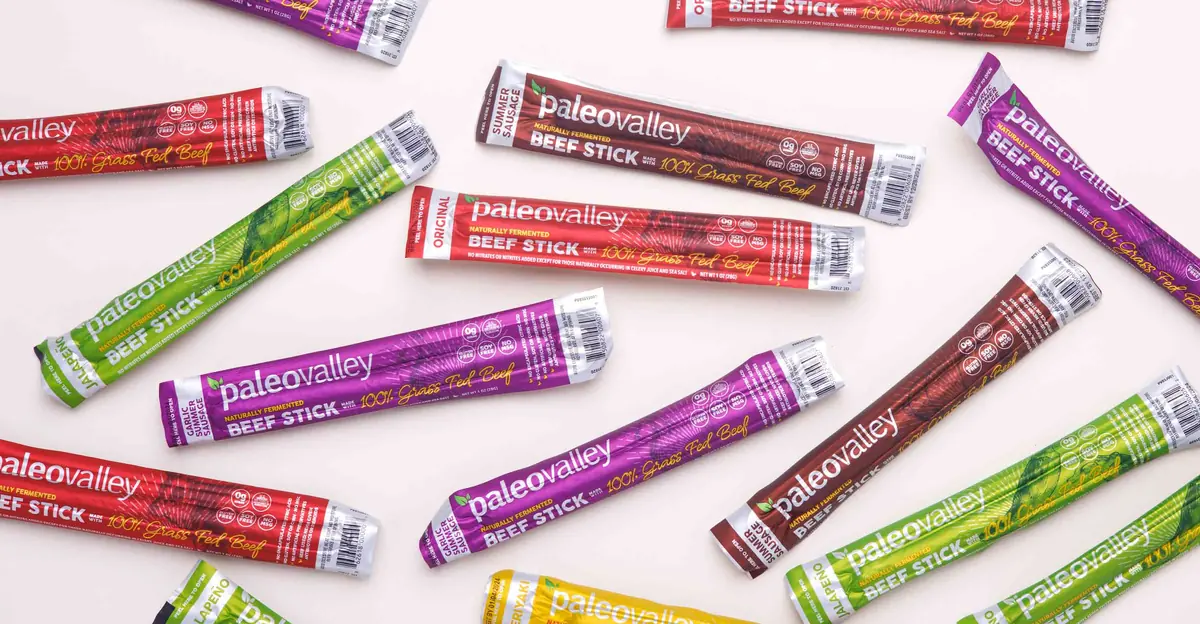
Five flavors of Paleovalley 100% Grass Fed Beef Sticks. Same format as the rest of the aisle. Very different build.
A meat stick is a format, not a quality standard. Two sticks can sit side by side on the same shelf, cost within a dollar of each other, carry the same words on the front, and be built in completely different ways.
I learned to read labels the hard way. I spent more than a decade with digestive issues that no expert could resolve. What finally worked was not a prescription. It was food, and specifically food I could identify by name. That is also why my husband Chas and I ended up making our own products instead of buying them.
So this is not a list of villains. Some of what follows is genuinely fine for some people. But all seven exist for one reason: they make a stick cheaper, faster, or more uniform to manufacture. None of them exist to make it better for you. Here they are, in the order I check them.
The audit
This is the ingredient almost nobody has heard of, and it is the one I check first. A meat stick has to be shelf stable at room temperature for a year, which means the pH has to drop. There are two ways to do that. You can ferment the meat with a live starter culture, which takes days. Or you can add acid directly, which takes minutes.
Encapsulated citric acid is the shortcut. It is citric acid, typically derived from GMO corn, coated in hydrogenated oil so it does not react until the stick is cooked. Fast, cheap, perfectly consistent batch after batch. In our experience, virtually every other snack stick on the market uses it, including the ones marketed as clean.
The tell that a stick was actually fermented instead is the opposite: a named starter culture plus a small fermentable carbohydrate for the bacteria to eat. If you see acids and no culture, you are looking at a stick that was acidified, not fermented.
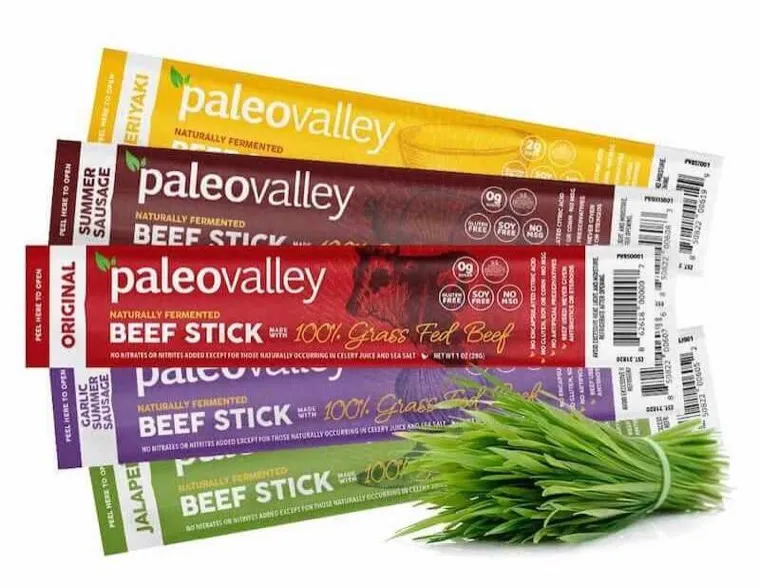
Every cow on earth eats grass at the start of its life. The question that matters is what it ate at the end of it. A very large number of products say “grass fed” and then finish the cattle on grain for the last few months, which is enough to change the biological makeup of the animal: a more inflammatory fatty acid profile, fewer vitamins, fewer minerals.
That is not a rounding error, and it is not disclosed on the front of a pack. The phrase you are looking for is grass fed and grass finished. If a brand only says the first two words, assume the last few months happened in a feedlot.
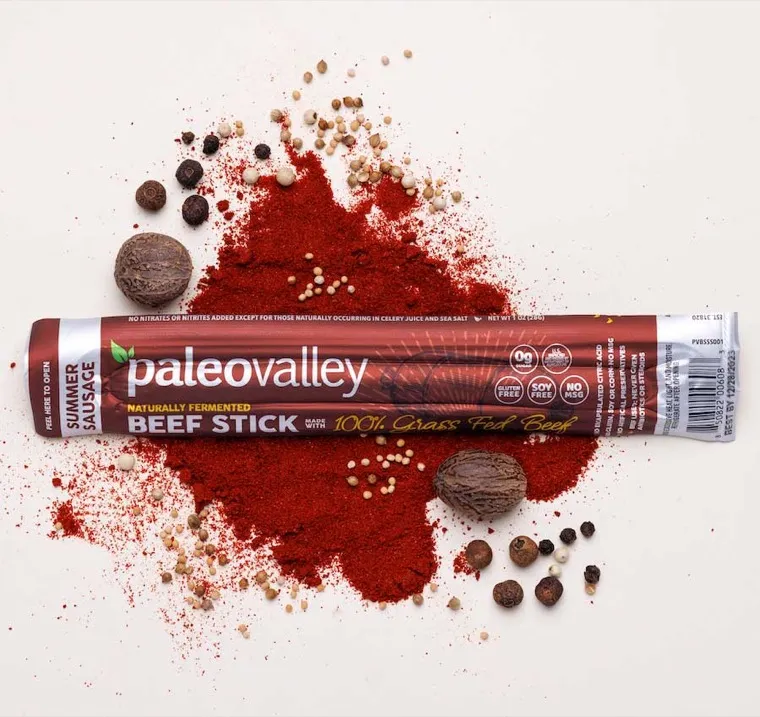
Spices are the easiest line item in the whole formula to quietly downgrade, because nobody audits them. Conventional spices are typically sprayed with herbicides and pesticides, then irradiated. They cost a fraction of organic ones and no customer has ever noticed on a label.
I think that is backwards. Spices are some of the most antioxidant rich foods on the planet. Spraying them and then irradiating them is not a process I want anywhere near a product I feed my son.
A plain meat stick does not need sugar. Sweetness shows up anyway, usually in teriyaki, maple, and honey styles, and often in small amounts to balance salt and heat. That can be a legitimate flavor choice. What it should never be is a surprise.
Scan for syrups, honey, cane sugar, brown sugar, coconut sap, and anything described as a sauce or a glaze. And check the last third of the ingredient list, because that is where the small additions hide.
Fermented sticks often list a tiny amount of dextrose, and people flag it as hidden sugar. It usually is not. In a fermented meat, dextrose is there to feed the bacteria during the ferment, not to sweeten the stick. In ours it is about one quarter of one gram per stick, and third party lab analysis confirms zero grams of sugar in the finished product.
Judge the sweeteners by what is left at the end, not by what went in at the start.
These three do the same job from different angles: they make inexpensive meat taste like something. “Natural flavor” is a regulatory category, not an ingredient, and it can cover a long list of compounds you will never see disclosed.
My rule is simple. If a flavoring is not a food I could buy separately and put in a jar, it does not belong in something that should be meat, salt and spices.
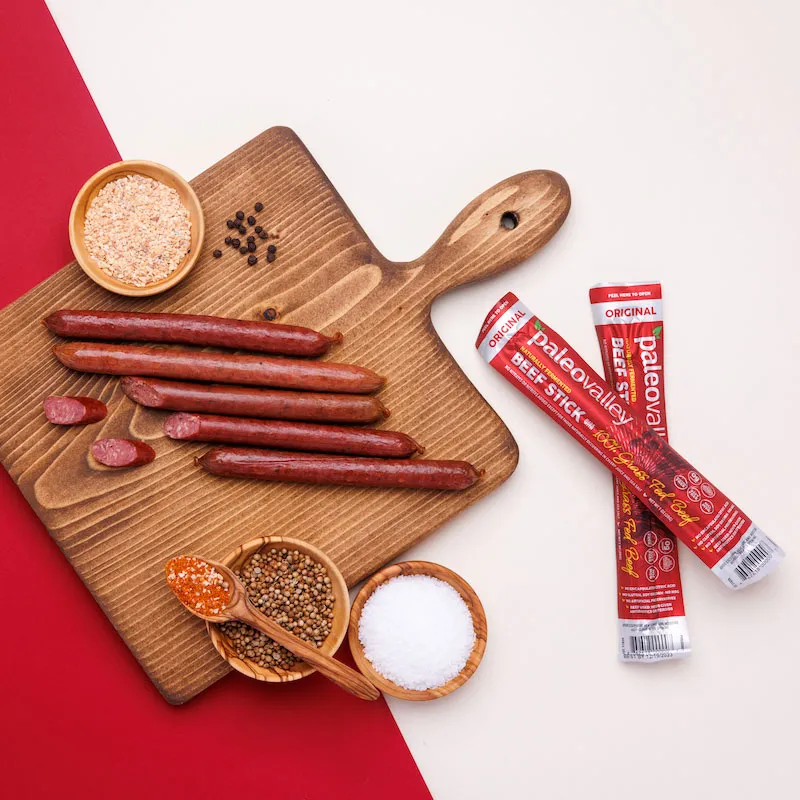
Protein isolates and starches get added for bite. Oils get added for mouthfeel. Individually none of them is dangerous. Together they move a product away from being a piece of seasoned meat and toward being a formulation that happens to be shaped like one.
The practical test: read the ingredient list out loud. If it takes longer than a breath, or if you hit a word you cannot picture as a physical thing, you are holding an engineered snack.
Fat goes rancid. A stick that has to survive a year of warehouses, trucks and gas station racks needs that handled, and the cheapest way to handle it is synthetically: BHA, BHT and their relatives, sitting quietly at the bottom of the list.
Salt, drying, real fermentation and good packaging can do the same job. They are slower and they cost more, which is exactly why they are the minority choice.
This is the one where I have to include my own product, because the whole category leans on it.
“Uncured” and “no nitrates added” are labeling categories, not chemistry. If a stick contains celery juice or celery powder, it introduces nitrate that converts to nitrite during processing. Functionally, that is still curing. Our sticks contain celery juice powder. That is why we say no artificial nitrates or nitrites, and not no nitrates.
If a brand tells you their uncured stick contains no nitrates at all, they are either not reading their own label or they are counting on you not to.
Two sticks can have near identical protein and very different sodium. Shelf stable meat is salty by design, so if meat sticks are a daily habit rather than an occasional one, sodium becomes the filter that matters most.
Ours is 220 mg per stick, which is 10% of the daily value. I would rather print that here than let you find it later.
The 60 second version
If you remember nothing else, take this to the shelf. It works on beef, chicken, pork and venison sticks equally.
What we made instead
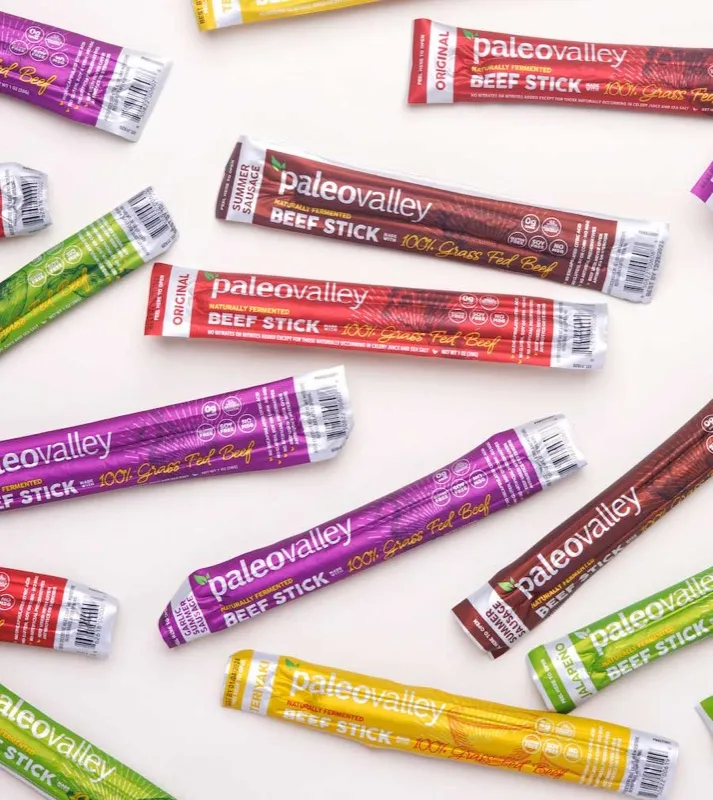
Original · Jalapeño · Summer Sausage · Garlic Summer Sausage · Teriyaki
They are, as far as we have ever been able to find, the only beef sticks in the USA made from 100% grass fed and grass finished beef and organic spices that are naturally fermented. The cattle are raised on pasture by family farmers in the United States using rotational grazing, never fed grain, never given antibiotics or hormones. The ferment is the old world kind, with a live starter culture, which is what makes the stick shelf stable without encapsulated citric acid, and what leaves gut friendly probiotics behind.
*The % Daily Value (DV) tells you how much a nutrient in a serving of food contributes to a daily diet. 2,000 calories a day is used for general nutrition advice. Values shown for Original, Jalapeño, Summer Sausage and Garlic Summer Sausage. Teriyaki contains 2 g of sugar from organic honey.
No account, no quiz. It opens straight on the product page.
What people actually say
The beef sticks alone have collected more than 44,000 customer reviews. These are recent ones, in their own words.
My wife and I bought these thinking they’d at least be a good source of protein even if they taste like Slim Jims. Well, they do not, thankfully. Rather you can taste the quality of the meat and can tell the beef is different. It’s clean and without fillers. So, all we now say…is more please!
Diabetics are always searching for high quality protein snacks that are low in carbohydrates, especially sugars. These beef sticks have been a lifesaver for me. I just grab and go and always have access to a clean and delicious no hassle snack.
As an 80 year old woman, my son was insistent that I needed more protein in my diet. I’m not a great morning breakfast eater, but I decided to try these beef sticks and it has been fantastic. Since I am really careful of my diet and try to eat everything organic, the Paleovalley Beef and Chicken sticks are a brilliant complement to my diet.
We love the taste of the beef sticks and we love that they are not full of junk like most! The original, garlic summer sausage, and jalapeño flavors are my favorite. The maple bacon pork sticks are really good too!
I keep a supply in my car for an on-the-go snack between clients as a mobile therapist. It’s so helpful. And keeps me on my keto plan too! I haven’t had any issues with them getting overheated or frozen or weird from temperature changes either.
And the people who read labels for a living
As a Culinary Nutrition Expert, the ingredient list is the first thing I check when evaluating a new food product. I absolutely love how intentionally clean Paleovalley meat sticks are: 100% grass fed/finished beef. The best!
We are big fans of the Paleovalley grass fed beef sticks. They are my go to food when traveling because they are high-protein, portable, shelf stable, and are gut-friendly.
Paleovalley and beef sticks are my lifesaver! They are literally in every bag I carry with me when I leave home so I’ve got a gut + skin friendly protein snack whenever I need it. Plus they taste so much better than any of the other beef sticks I’ve tried.
Why we ended up making these

Paleovalley started because of a problem, not an opportunity. I had severe digestive issues for over a decade and no expert could resolve them. An ancestral diet did, and it sent me into a career in holistic nutrition instead of the one I had planned.
What frustrated us afterwards was the shelf. Every product was “gluten free” or “natural” on the front and something else entirely on the back. So Chas and I, with his brother and a close friend, started making the products we could not find. That is still the whole business model: we prioritize quality over cost, and we keep a Never Ever list that includes no GMOs, no corn, no seed oils, no MSG, no artificial nitrates or nitrites, no refined sugar, no grains and no ultra processing.
Five beef flavors, plus pasture raised chicken, pork and 100% grass fed venison sticks. Mix any of them, in any combination, and the per pack price drops as the box gets bigger.
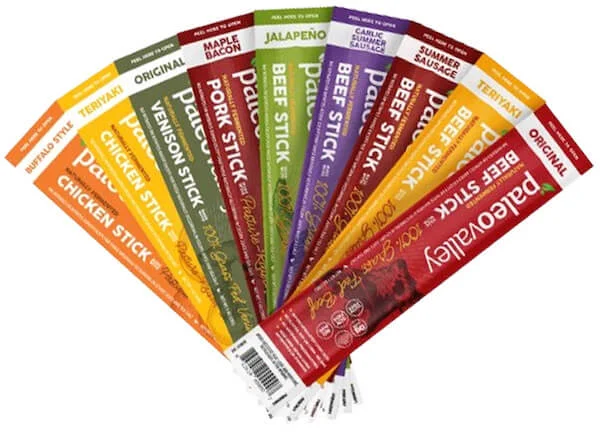
Every pack contains ten 1 oz sticks. Free shipping on 4 or more packs, or on any US order over $75. Subscriptions can be paused, rescheduled or cancelled online at any time. Prices shown as listed on paleovalley.com in August 2026. Live promotions may be better than this.

Questions we get asked
No. They are shelf stable at room temperature for one year. They last even longer refrigerated, and they can be frozen for a year, then thawed at room temperature.
No. It comes from organic cassava root and it is there to start the fermentation. We use roughly one quarter of one gram per stick, and by the end of the ferment there is little to none left, because the probiotic bacteria have consumed it. Third party lab analysis confirms zero grams of sugar. The exception is Teriyaki, which contains 2 g of sugar from organic honey.
No. They are free from GMOs, gluten, grains, corn, soy and dairy, and also from antibiotics, steroids, hormones, artificial nitrates and nitrites, encapsulated citric acid and hydrogenated oils.
Each pack holds ten 1 oz sticks. Four or more packs unlocks both the lower per pack price and free US shipping, which is why most people start there. If there are children in the house, plan for the packs to disappear faster than you expect.
Then you have 60 days to tell us and we refund the product price without any questions asked. That covers any Paleovalley product, opened or not.
Free US shipping on 4 packs or more.